When I first started managing a remote team, I thought “no office” simply meant a different way of working. We used Slack for communication, Zoom for meetings, and email for client inquiries—it all seemed very modern. However, once we began serving global clients, I realized the biggest challenge wasn’t collaboration itself, but the phone calls. With clients spread across different countries and time zones, phone communication became both critical and chaotic.
At the time, our team was scattered across three regions: Asia, Europe, and North America. On the surface, we were a “global team,” but in reality, we were operating in silos. It wasn’t until we adopted Calilio that we truly transformed from a “dispersed team” into a “unified company.”
We tried various methods, but none were ideal
Initially, we tried a rotating schedule for answering calls, but it quickly proved unsustainable. Time zone mismatches meant some team members were woken up at night, while others were in meetings during the day and couldn’t answer; consequently, the client experience became highly inconsistent.
We then tried cobbling together different tools: WhatsApp for general communication, Zoom for meetings, mobile phones for calls, and email for after-sales support. The result was a fragmented system where issues became disjointed—resolving a simple client query often required switching back and forth between multiple platforms.
We gradually realized the problem wasn’t a lack of tools, but the absence of a unified telephony system.
The turning point: Adopting Calilio
The real shift occurred once we started using a cloud telephony system.
We ultimately chose Calilio. What initially attracted us was simple: the ability to consolidate global calls into a single system. However, once we started using it, we discovered it solved far more than just “answering calls”—it transformed our entire communication structure.
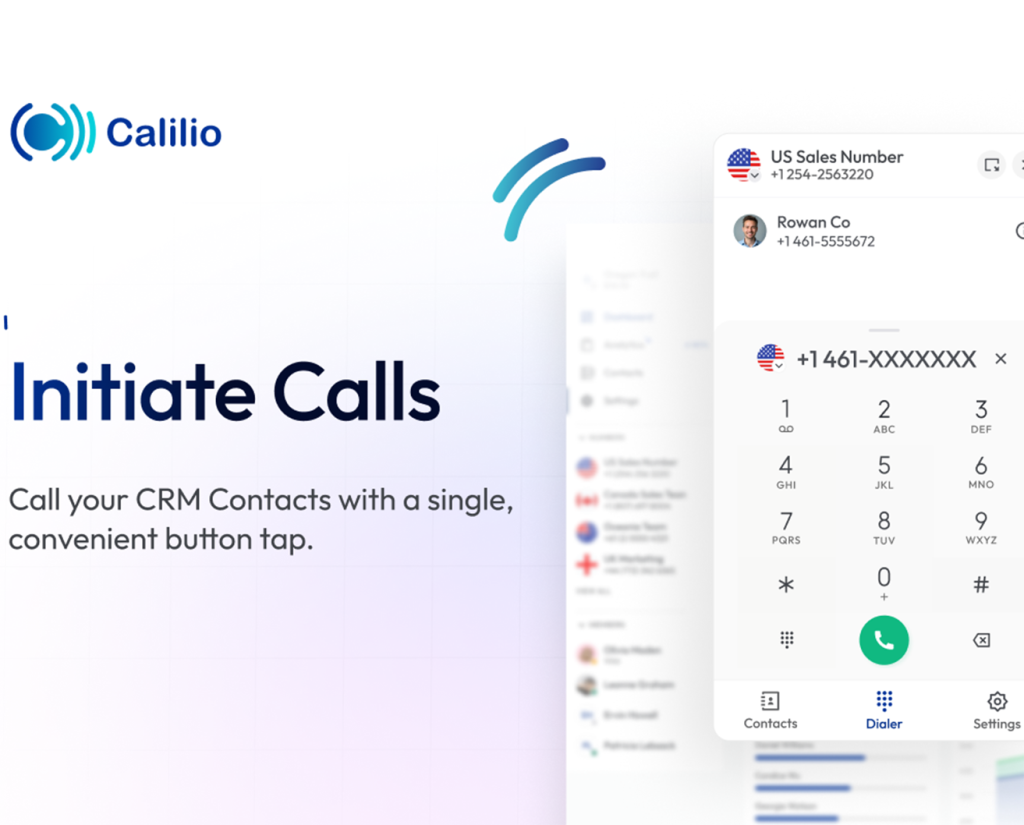
The first step we took was consolidating all our scattered contact points into a single system number. We completely eliminated our reliance on personal mobile numbers, ensuring all incoming client calls were routed through one central entry point.
Global numbers and a unified entry point make us “look like a local team”
The most noticeable change was in how clients perceived us. In the past, clients would often call and ask, “Which country is your company based in?” or “Can I really reach you at this number?”
However, once we set up virtual numbers for different countries using Calilio, those questions vanished. US clients see a local number, UK clients see a local number, and Australian clients do the same.
Although our team is distributed globally, in the eyes of our clients, we have become a “local company.” One client even made a remark that left a lasting impression on me: “You sound just like a local team.”
In reality, we might be collaborating remotely across three different time zones.
AI-driven routing and call logging: Bringing structure to chaos for the first time
More importantly, Calilio is not just a telephony tool; it functions more like a management system.
Previously, the biggest issue was that calls would be answered, but no one knew what happened afterward. Now, every incoming call is fully logged—including call duration, the client’s number, the content of the conversation, and routing details. Furthermore, the system automatically assigns calls to the right person rather than just ringing randomly.
Technical issues are routed to the support team, business inquiries go to the sales team, and existing clients are automatically matched with their original account managers. These changes have completely eliminated redundant communication. We no longer have to ask, “Who handled this client?” “What did they say?” or “Was there a follow-up?” The system organizes all that information for us.
Remote teams working in true synchronization for the first time
Before using Calilio, our remote team worked in parallel—everyone handled their own tasks and aligned via meetings. But once we unified our phone system, we experienced the concept of “synchronization” for the first time.
When a client in the US calls, the system automatically routes the call to the North American sales team. If no one answers, it automatically transfers to a backup team member, while all team members can view the complete call record. The entire process is transparent; there are no information silos or communication gaps.
Simultaneous improvements in customer experience and cost efficiency
Initially, we thought Calilio was just about boosting internal efficiency, but we soon discovered that the impact far exceeded our expectations. Customer wait times dropped significantly, issues were resolved faster, complaints decreased, and overall satisfaction rose—even our closing rates improved. Interestingly, some clients even remarked that we had “become more professional,” when in fact, all we had done was switch to a unified phone system.
At the same time, this system has delivered dual benefits: reduced costs and improved management efficiency. Previously, we relied on a patchwork of SIM cards, international numbers, and various tools to handle global communication—a setup that demanded significant management effort and increased the risk of errors. Now, all communications are centralized on the Calilio platform; international calling costs have dropped significantly, and management has become far more streamlined. Most importantly, we no longer rely on personal mobile numbers, which has markedly enhanced our security and operational standardization.
What remote companies truly need isn’t just tools, but a “unified gateway”
The longer I manage a remote team, the clearer one fact becomes: the problem isn’t a lack of tools, but rather that tools are too fragmented. Email, chat apps, and conferencing software are all excellent, but telephony has always been the hardest element to unify.
Calilio’s value lies in transforming global communication into a cohesive system rather than a collection of disjointed tools.
A company without an office can still be highly “stable”
Many people perceive remote companies as unstable, prone to communication chaos, and inefficient in execution. In our experience, however, the real issue isn’t remote work itself, but a lack of systems. Once we handed our telephony infrastructure over to Calilio, everything fell into place.
Clients know exactly which number to call, the team knows who is responsible for which client, and managers have visibility into all communication logs; the entire company is actually more stable and transparent than before. Looking back, we aren’t a “company without an office”—we simply moved our office into a digital system, and Calilio serves as one of the key pieces of infrastructure that makes this possible.